lunedì 24 marzo 2014

Late Imperial Roman Army 15 mm

I started to paint miniatures around twenty years ago.  I'm keen of roman history and so my choose was a logical consequence. In that period I was a student  and, to save money, I bought a box of 15mm Essex roman army. Acting on impulse I painted them without a real study of the uniforms, weapons, shields and so on.

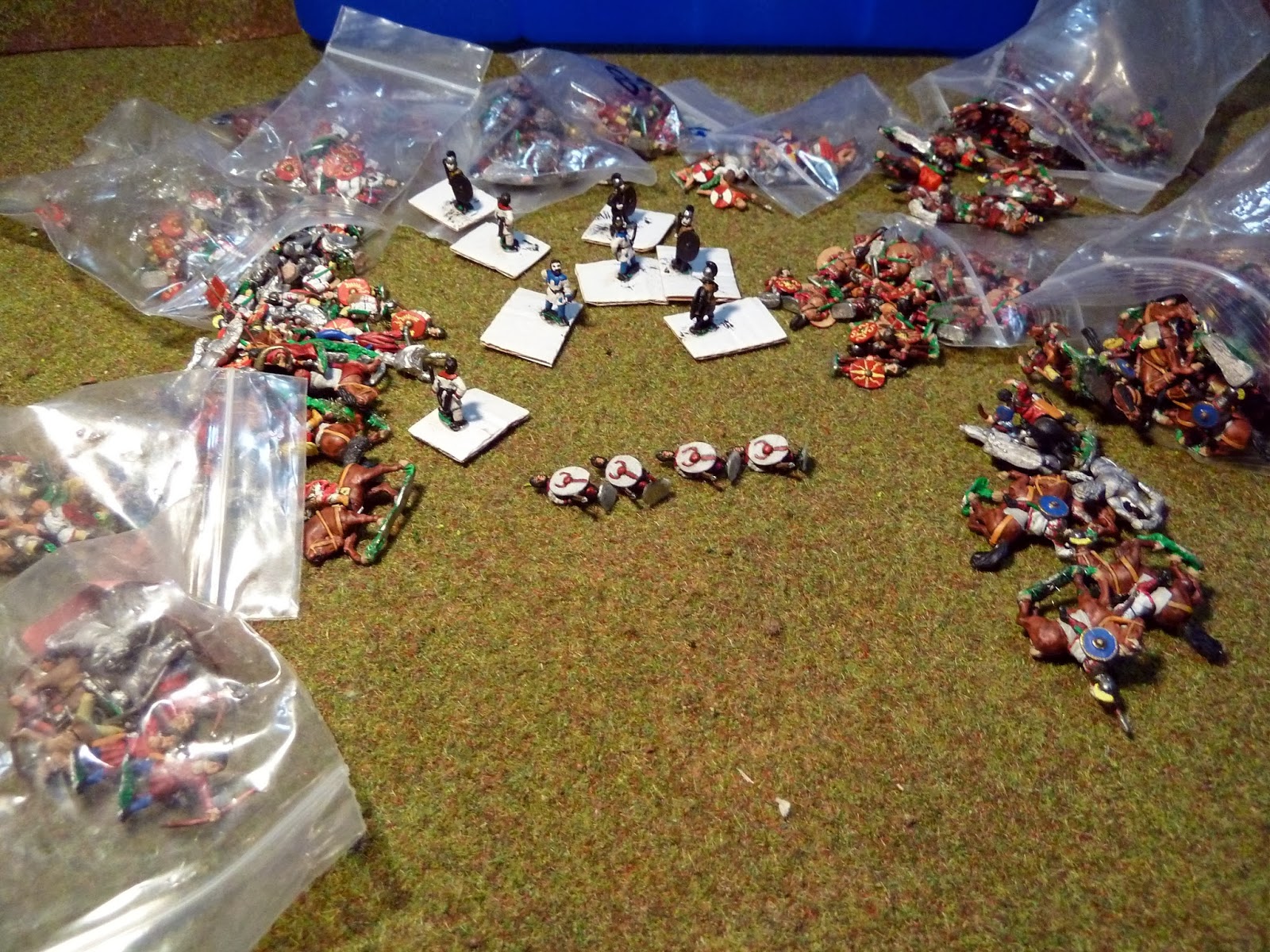
Last December I took again my old miniatures and I decided to re-painted them ... the situation could be substantially reported in these photos


On the left site the new version ... generally I prefer the 28mm. The detail level of 15mm is not hight as I would ... I did my best


Today the situation it is a bit changed ... 


The army composition is based on Dbmm book 3: 20 psiloi, 11 light cavalries, 17 blades, 18 auxiliaries, 12 warbands, 2 artilleries, 5 command groups and 11 regular cavalries ... around 290 miniatures.

This time I prepared the army better. I don't want to write a book on late roman army but I think that it is necessary a brief introduction. 

First of all a detail: late roman army is the Roman Empire force from Costantine's reform (around 4th century) till the fall of its western part. In that period the high command was divided between emperor, magister peditum, equitum, dux and the term "legion" was only a memory. The army included many units that maintained names and titles more for  tradition than for a real specialization. 
The army was, to be brief, divided between palatini/comitatenses/scholae (the field army) and limitanei/pseudocomitateneses (the border force).

The cavalry


The first line is composed by cataphractarii. Their equipment shows Sarmatian influences with armoured horses, the long lance called contus and the scale armours (lorica squamata). The Notitia Dignitum reported that only a unit of these cavalrymen remained in the west during the 5th century. Effectively the Cataphracatarii were more frequent in the east. 


Light cavalry was the core of the mounted reserve of the 3rd-4th century. The three units on the left are equites sagittarii the other are equites illyricani. The sagittarii were created probably in the east to help Roman army against Persian and Hunnic troops. On contrary Illyricani were recruited from the frontier of the Balkans.

The infantry


In the foreground of the second photo the bulk of the roman army: some comitatenses units. From left to right: the britones seniores, the lanciarii iuniores, the prima flavia gemina tracia and the armigeri defensores seniores. All 17 blades of my army are a unit described in the Notitia dignitatum and all shields are handmade.

Another photo with some details of a command group back 


Limitanei and pseudolimitanei


Limitanei were the "border army" and they are  wrongly considered a militia of local farmers. They fought incessantly the barbarian raids and it is therefore likely that their combat readiness and experience were higher.
As for my comitatenses forces all auxiliaries were specific Notitia units. In the foregorund from left to right: the fortenses, a unit of auxilia palatina, the cornuti seniores, the batavi, the iovii iuniores gallicani
Shields of the second lines are based on the Italian villa armerina mosaics.

And to complete a group of Goths warbands


Goths were a Germanic tribes that played an important role in the fall of Roman Empire but for centuries they served as auxiliaries in Roman army.

domenica 23 marzo 2014

British and French Napoleonic Army Cavalry - Part 3

To complete my Napoleonic armies I prepared some cavalry squadrons.

For the French I painted two regiments of heavy cavalry: one of carabiniers, another-one of cuirassiers, and two units of dragoons


The picture above represents four bases of the 10th cuirassiers regiment; with the carabiniers they were the shock cavalry of the Napoleonic period. During Waterloo battle Napoleon deployed on the field twelve regiments of these soldiers. The regiments generally were armed and equipped identically. The only differences was the colours of the collars and of the cuffs.


The carabiniers unit on the centre of the picture is a squadron of the first regiment. I painted them in their campaign dress (blue in stead of white) even if frequently I saw them ...  in some wargamers' posts ...  with the parade uniforms.


The units of dragoons I painted are the 7th and the 10th. They were largely used during peninsular wars but only two regiments of these cavalrymen were on the field during the 100 days campaign.

The British regiments I prepared are all of light cavalry


In particular I painted twelve bases of  the 7th Hussars and  four of the Verdun 1st squadron.


The British hussars had a marginal role during Waterloo campaign but 7th regiments were largely involved during peninsular wars with the 10th.

Finally I tried to recreate, thanks a couple of photos, the effect of a French cavalry charge against a British square


lunedì 24 febbraio 2014

Dbmm Feb, 2014 battle report


During the last two weeks I started officially my Late Imperial Roman Dbmm tests.
The first match involved Late Imperial Roman against Later Hoplite Greek.

Riccardo took the command of the Spartans while the Romans, of course, are mine.
Riccardo M. used his list reported by Lorenzo M. into Tagmata site.
(http://www.tagmata.it/ii5_later_hoplite_greeks__spar.htm)

My list was:

West Late Imperial Roman
Cic 1 CvO, 6 CvO, 4 LhO, 2 LhF, 2KnF, 2BgeF [28]
Sub 1 BdO, 12 BdO, 2 BdX, 2 ArtF, 2 BgeF [24]
Sub 1 BdO, 10 AxS, 10 PsO, 4 PsS, 2 BgeF [28]

I deployed my cavalry on the right, blade at the center and auxiliaries as left wing.


The Riccardo's steamrollers are coming.


My original plan was keeping a static defense with blades and auxiliaries while my cavalry outflanked the enemy left . Unfortunately, due to my inexperience, my right wing was too slow and so Riccardo had the possibility to arrive without problem till my center. Furthermore, Riccardo screened his spears with a line of Psiloi, force my blades to charge.


The foregone conclusion is a complete defeat of my army with two general (one is the blade on the left of the photo below) destroyed


Lessons:
- do not deploy blades without a screen of psiloi. It is not a great idea to think that psiloi can be used only to support blades against cavalry.
- if you decide to deploy a wing of cavalry to outflank the enemy, it is a good idea to use all pips I have to do it not to wait that the enemy arrives blocking you with his treat zone

The second battle was Late Imperial Roman against New Kingdom Egyptian

My opponent was again the patient Riccardo M.
New stike, new experimental army list:
East Late Imperial Roman

Cic 1 CvO, 4 CvO, 3 LhO, 2 LhF, 4KnX, 2BgeF [25]
Sub 1 BdO, 12 BdO, 2 BdX, 6 PsO, 2 BgeF [25]
Sub 1 BdO, 12 AxS, 10 PsO, 4 PsS, 2 BgeF [27]

My roman army is not completely painted but I reached a number of bases sufficient to prepare a line of battle.


I deployed cavalry on the left, blades on the center and auxiliaries as right wing. The field is substantially open with only a Bua on the middle of the table.


My opponent chose Tucmoses III as CiC, a brilliant general. It was the first time I fought against this kind of Dbmm option. My original plan was to attack with the cavalry but Riccardo moved his right flank more quickly than I expected (12 pip ie 6 pip standard increased by two ... brilliant general docet) and so I was again subject to his TZ.


To support my left flank I sent some auxiliaries from the right wing


While on the left the situation is changing with my KnX that threatened the enemy CvS


At the center my line held the position while the remaining auxiliaries tried to attack the enemy left flank


This time, thanks to support of Marco D. that helped me as advisor, the conclusion was less catastrophic than the previous-one with an enemy Sub Commander destroyed agaist a couple of my blades.

Lessons:
- do not deploy two complete commands of infantry. The AxS are good troops but to slow

lunedì 27 gennaio 2014

Dbmm Dec, 2013 battle report

It's been a long time since the last time I wrote in the post. Unfortunately, in this period, I'm very busy and I had some problems to play.

Starting from December I restart to play DBM or better DBMM. It is a very complex rule book and with significant differences respect DBM.

I'm preparing a late roman army but unfortunately I'm not finished yet. A DBMM army is very long work to complete if you want arrange all options included in a Baker's list.

Some photos of my first battles ... 

Dec 30, 2013: Late Imperial Roman vs Macedonian Early Successor.


The Macedonians are painted by Riccardo and commanded by Filippo. Late Imperial Roman are painted and commanded by Marco D. and (partially) by me. To be honest my contribution in miniatures was limited to ten base (partially reproduced in the photo above as the four roman auxiliaries with the brown bases on the right). 


I was assigned to left wing but the struggle was fought principally at the center.. The Macedonians elephants walk literally on the Gothic warbands while, on the right roman, artilleries and archers try to slow down Macedonians forces but … without success. An the left Romans and Macedonians watch reciprocally.
Romans lost the battle

In January other two battles
Macedonian Early Successor hoplites vs Huns


Greeks are painted by Riccardo and Giancarlo and commanded by me. Huns are painted and commanded by Filippo. It was a training battle in which I remained in a defensive position. The battle was concentrated on my right wing and it was substantially a tie … cavalry against cavalry.


Another training struggle in January
Macedonian Early Successor against Alexandrian Macedonians


Macedonians are painted by Riccardo and Giancarlo and commanded by me. Alexandrian Macedonians are commanded by Giorgio. A collapse for Early Successor. I tried to push my phalanx against the enemy center but Giorgio was very skilled to avoid a direct contact that could be disastrous for his troops. I wrongly assigned the highest dice to phalanx while Alexandrian knights destroyed my left wing that wrongly had psiloi in the first ranks.

lunedì 23 dicembre 2013

French Commanders - Part 2

Last week I finally finished all my French officers and so I took some pictures.
A  French mounted colonel


A typical 1813-1815 senior officer wearing regular uniform with the waistbelt specified for mounted officer.
Other two cavalry officers


On the left a Carbineer and, of course, on the center a Dragoon. The cavalry suffered more than other corps for the loss of experienced aristocratic officer due to revolutionary purges. Napoleon worked very hard to recreate new officer staff dividing the cavalry in two different group: heavy (ie carbineers and cuirassiers) and light (ie dragoon). In the picture above there are a 10th  Carbineer Regiment and a 22nd Dragoon Regiment commanders

An Old Guard captain. This Corps was composed by veterans who had served three to five campaigns in Napoleon's army.


I painted an half dozen of officers, someone on foot and other mounted. But the pieces I prefer are the models below.
It is mainly a group of Perry miniatures. The originals are below:

[Copyrights Perry Miniatures]
A changed a bit the structure and so I created two different commands: a CiC with Napoleon and second with General Drouot.

The first is compsed by Drouot, an hussar ADC with 1815 uniform and a major 


The second base is the CiC: Napoleon, the bravest of the brave Marshall Ney, Marshall Soult, and  Colonel Gourgaud 


domenica 22 dicembre 2013

New Year … new projects

I insert into the blog some photos of my future projects hoping that in that way I’ll be more incentive to complete them.

The first project started after that Ezio M. has recruited some La Piccola members to prepare miniatures for French Indian wars scenarios. Thanks his usual skills he is coordinating four of us to  prepare a English/French regiment each.

My duty is to prepare La Sarre regiment.  The regiment was risen with Lorraine boys in 1756. It was sent to Quebec and participated to Fort Oswego and Fort William Henry siege. It served under the mythic Gen Louis de Montcalm during Battle of Carillon. Using other words … it was one of the force strongly involved into French Indian wars.

I have to prepare also some compagnies franche de la marine … another typical French-Indian wars peculiarity.  I was very surprised to understand that this force was created by Cardinal Richelieu in 1622.

Finally a dozen of Courriers de Bois and some civilians.  Totally 73 miniatures.

At today I finished 6 marines and three Indians. Last order (around 30 miniatures) arrived only four days ago … a Christmas present that I just received even if December 25 will from two days.


The second project  is a trip down memory lane … I started my hobby twenty years ago. My favorite period is the roman age so the first army I bought was a box of 15mm essex miniatures. I painted them … or better I thought to have painted them. The problem is that twenty years ago I had not the same ability to paint that now I have.
Last Sunday I decided to take the army again … and so I decided to re paint all the miniatures … around 300 pieces.


The target  for next year is to prepare a DBMM late imperial roman army. Casually last Saturday I assisted to a DBMM battle between a late imperial roman and a Tamerlan army.
I have a lot of Osprey publications for both  Roman and Byzantine period and I started to brush up the Notitia Dignitatum.

Presently I finished only four cornutii seniors auxilia. Now it remains 296 small pieces of lead ...

sabato 21 dicembre 2013

War of the roses

Last summer, during one my usual “visit” to my favorite miniatures shop, Goblin Torino,  I saw some War of the Roses Perry boxes. The miniatures have excellent poses and they are in plastic … the material I prefer.  So I decided to buy three boxes: two war of the roses and one of mercenaries.

It was the first time I painted war of the roses and, so, I bought some Osprey publications to be sure of choosing the correct colors schemes for the different liveries.

I concentrated my attention on the first period of English civil war 1455-1461. The period that ending with one of the bloodiest battles of the war: Towton.

Two weeks ago I played with Saga rules: the tomahawk studios wargame. There are no official Saga armies for those battles and, currently, I’m the only club member with the war of the roses miniatures but I designed my “warbands” using this game system

Twelve Yorkish archers with their warriors


The first struggle of the war can be considered the fist St Albans battle. It was a Yorkish victory even if Edward IV had around 7,000 men against the 2,000 Lancastrian troops.

Henry Beaufort men


Other pictures of the two armies


And finally  a particular of the two command groups


I prepared two contingents of allies.
The first was a group of Earl of Northumberland men


and a group of Warwick troops


And finally an half dozen of men at arms in action