domenica 18 giugno 2017

WWII Battle of Monte Cassino - Green devils June 2017

The Battle of Monte Cassino was a series of assaults performed by the Allies against German forces during the Italian campaign of ww2. 
This battle is sadly famous (for us Italians) for the non-sense Allies HQ's decision to drop 1,400 tons of bombs on the monastery of Cassino that controlled the key valley of the Liri.
The destruction of Benedict of Nursia's monastery was the turning point of the battle. On February, 15 1944, after the failure of Allies raid, German paratroopers occupied the rubble and established excellent defensive positions amid the ruins.

This is an image of the battlefield days after the Allies victory publiched by LIFE (May 1944) 


 The German paratroopers unit that was involved in the battle was the 1st Parachute Division. They fought against Allies during Sicily invasion and later in the defense of the Winter line at  south of Rome. 
I decided to paint them using a mix of camo and not-camo uniforms. Below some historical images. The second-one is a photo taken in July 1943 (Sicily).


and some of my miniatures in action


Following Ezio's tip I decided to insert in this post historical photo and imagines of my figures

The photo below shows a real fallschirmjäger scanning the landascape on Monte Cassino. In the second photo I imagined the same fallschirmjäger after perfor his duty speaking with his comrades.


I painted also a doctor. Unfortunately the only historical colorized photo I found was taken in Normandy and the German doctor is not a fallschirmjäger but it is sufficient to justified  the colors I used


After the Allied bombardment the struggle was fought between ruins. Below some imagines


At the end other two photos of my miniatures. In the first-one in foreground a young lieutenant and in the second-one a group of soldier that are taking a new position with the effect of artillery in background


The last two imagines are a copy of the original alert to Italian population that threatened the bombardment and the first page of The New York Times that announced the American victory at Monte Cassino


Copyright The New York Times


Modern Armies: USCM May 2017

The last modern army that I painted are the US Marines. I started these miniatures after Milano Wargame (at the end of February) but I finished them only last month. 
I decided to paint the USCM with the multi-scale camo pattern (MARPAT). There are different type of camo pattern ... marine, desert and so on ... but I decided for the woodland.

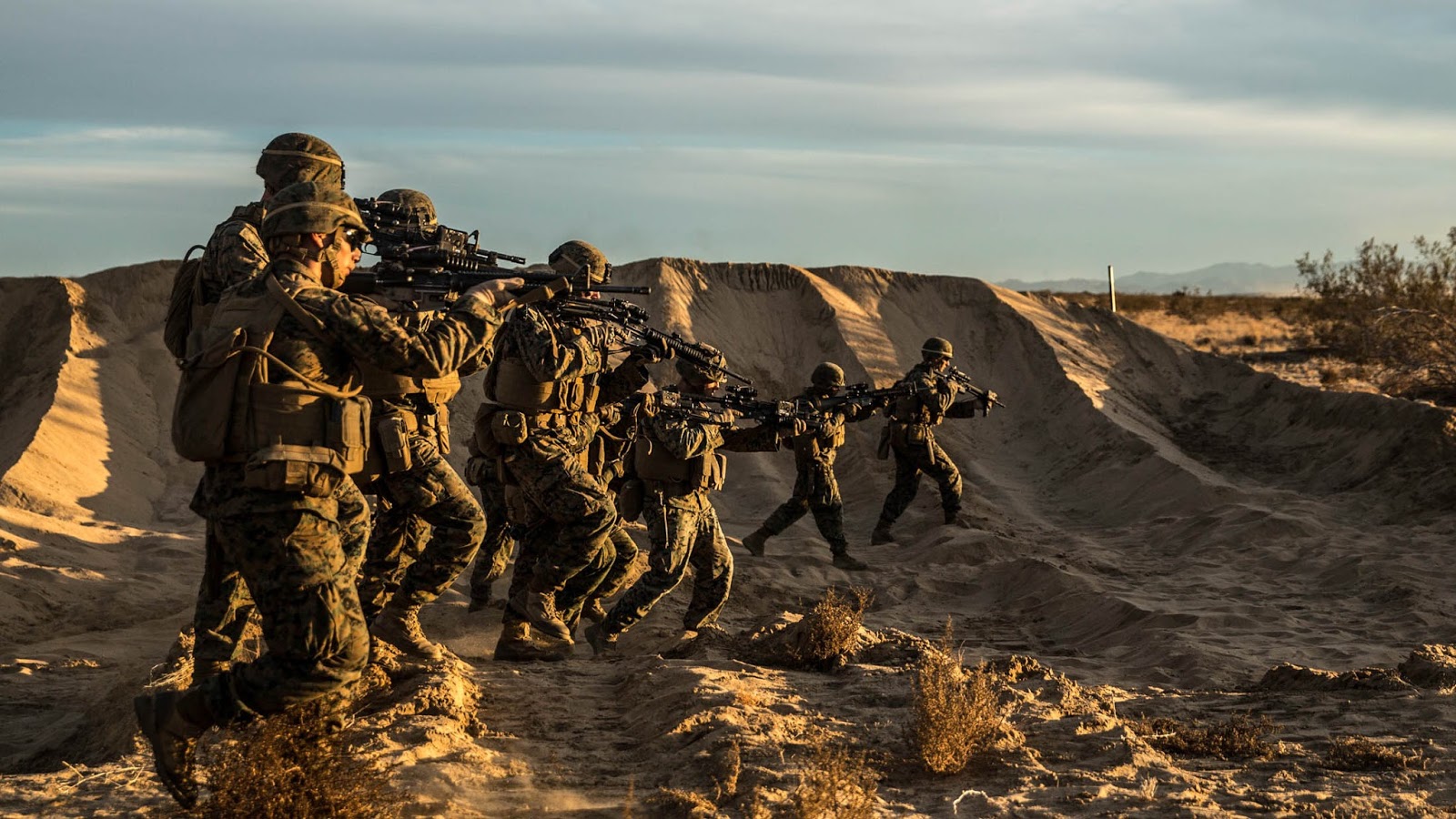
All photos of real USCM in action that you will see below are obtained from the official USCM web site while figures are all Caesar miniatures

http://www.marines.mil/Photos

This is an example of a group of American soldiers wearing woodland marpat


and below some of my figures in action


Obviously I painted also the supporting teams ... below two groups equipped with M2 Browning machine guns that cover the advance of some USCM


Below the original during a test fire at Camp Schwab. The M2 (called also Ma Deuce) is the oldest machine gun currently in the Marines' arsenal


Two 81M mortar with their crews ...


... and the original 


A FGM-148 Javelin launch rocket system in action on a club table and ...


... in the reality


I painted also a sniper team 


For experience woodland Marpat can assume different hues.


I decided for a darkest tone with green tactics and bags


And finally other imagines of my marines during an action in a Middle East village and ...


... in a joint operation with French troops


domenica 11 giugno 2017

Red army winter camouflage Ww2

"Winter is coming" is the motto of the House Stark, one of the protagonist of "The game of thrones" ... a tv series and a saga of books that is very famous in this period. 

I think that my club friends were ispired by this sentence when they decided to prepare red army winter camouflage considering that today, at my home, temperature was 35 °C.

Soviet army used mainly this camouflage during the "Winter war",  a conflict between the Soviet Union and Finland fought between 1939 and 1940. The background of the war included ice lakes, dark forests and rigid temperatures (−43 °C (−45 °F) on 16 January 1940).  

Mannerheim Line Wikipedia copyright
The war was won by Soviet army but only after a long and brave resistence of Finnish troops.

Below some pictures taken by Ezio of the miniatures prepared and painted by Riccardo and Flavio. All miniatures are 20 mm


The following photo is an original picture of Red Army in 1940


I found also a color photo of Ww2 Red Army winter camouflage during a military parade at Moscow

Copyright Marcus Cotton

sabato 10 giugno 2017

Rivarolo June,4 2017 - How it made - Part 3 La Piccola

The last part of this long post is dedicated to our the war games. 

All persons that have our hobby are keen on history and the possibility to share our knowledge with other is a great opportunity. Thanks to the work of all other my club mates and the initiative of Warzone President (Federico) last week I had this possibility.

During the day a significant number of persons visited the castle of Margrà in which we were and more of them asked us detail of our hobby


I took with me some of my miniatures and I prepared some depliant to easy explain how I prepared them


It was a great event well organized and that permitted us to find new friends and to play for a day in a fantastic landscape


Rivarolo June, 4 2017 - Peninsular War and The Crusaders - Part 2 La Piccola

This is the second part of a post in which I want describe the work performed by my club (La Piccola Armata) and by another local wargame club (Warzone) for a special event in which we were involved. The background was the fantastic castle of Malgrà at Rivarolo Canavese and the miniatures exhibition was organized by Federico (the Warzone President).

In this post I'll report the two scenarios prepared by La Piccola Armata.


In the first table Riccardo, Aurelian, Maurizio and Flavio played a battle set during the Peninsular wars between the Spanish and the French. 
Below an overview of the table


The battle saw the French attempt to outflank the Spanish with their cavalry


Below some details of the fantastic Spanish troops painted by Flavio


and some particulars of French units painted by me (the artillery on the landscape is painted by Flavio)


The battle was hard fought and, at the end, the Spanish decided to celebrate the victory in this way


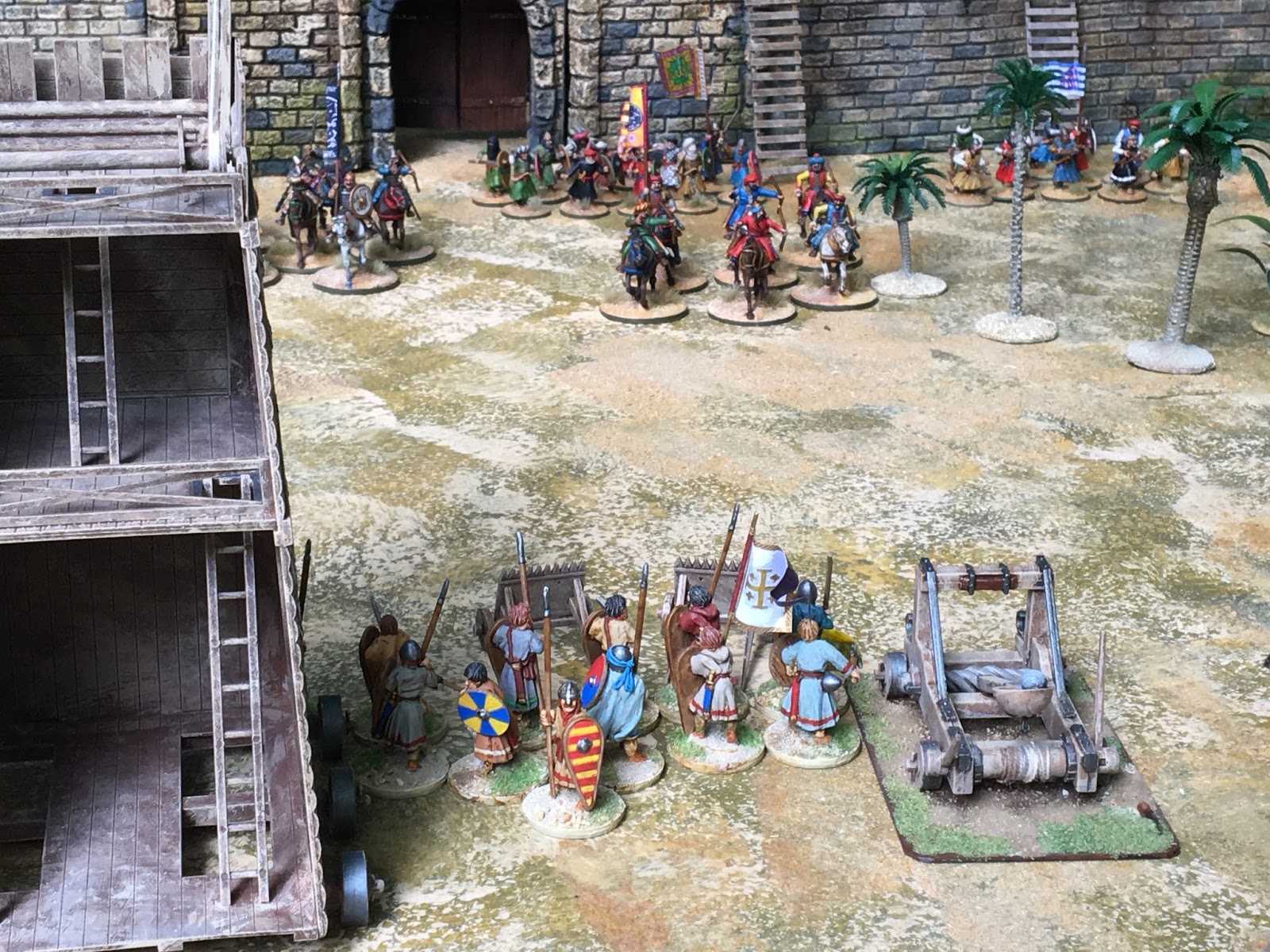
On the second table Biagio e Ezio recreated a part of Acri siege using Lion Rampart


The obj of the Saracens was to burn the siege machines. 


Below some pictures of the Saracens painted by Biagio and ...


... the Franks painted by Ezio


After a lot of turns the Saracens win burning part of siege machines