venerdì 21 luglio 2023

Studio Tomahawk'Jugula review

In the last weeks my club mates played some matches using Jugula ... a Studio Tomahawk rule system set in Roman Empire. Jugula is a bit different respect other "classical" wargame because you will be a "Lanista" in stead of a commarders, generals and so on.

The lanista was, essentially, an entrepreneur who traded in gladiators and rented them to the organizer (editor or munerarius) of the gladiatorial show (munera) drawing his own profit which did not diminish even if the gladiator died during the fight. 

Normally the lanista was an ex gladiator assisted in his activity by the doctores (or magistri). Skilled veterans freed from the status of gladiator who, having concluded thier activity, had been awarded the rudis (a wooden sword).

The lanista is the focus of the game ... this is the reason for which, in this game, the rules managing combat in the arena are all about decisions, rather than hit, move and blade types. Jugula allows the players to manage the development of their own gladiators. Combat area in a square grid ... not very different respect a chess board. 


Jugula uses a card system that, during the arena fights, allows the lanista to control and manage his gladiators. During the game the player has to choose the correct cards but also the correct way to use them. A card can uses: for movement, for increase your popularity (called Vox Populi that can give some bonus combat and increase the size of your card hand), for combat, for draw other cards, for use card's ability or for a kind of upgrade (Prima Jugula card).

The player has a team of 4 gladiators (famila). Every gladiator has his stat (movement, combat, skills and so on) and card. The player can choose from: Murmillo, Scissor, Hoplomachus, Provocator, Secutor, Crupellarius (heavy) and Veles, Tharaex, Retiarius, Sagittarius, Dimachaerius, Laquearius (light).

Generally you cannot attack and move in the same. You get bonuses for attacking the flank or the rear but you must choose your movement carrefully because you can attack only the three squares immediately to miniature's front

The combat is easy: your gladiator's attack factors (plus modifiers) against opponent's defence. Modifiers could be: the drawing card value you and your opponent must put on the table or Vox Populi for example.

Four points win the game. An enemy's gladiator wounded: 1 point. An enemy's gladiator killed: 2 points.

You can play it in a campaign version. Every players (Lanisti) spent money to train gladiators, to hire mercanaries, to sell or to buy new minis and so on. The lanista goal is to gain glory and to win the game.

The game is easy to play and funny. In our club we started a campaign that is rich of interesting and amusing combats 


venerdì 23 giugno 2023

Maxi Napoleonic scenario - Black Powder June 17, 2023

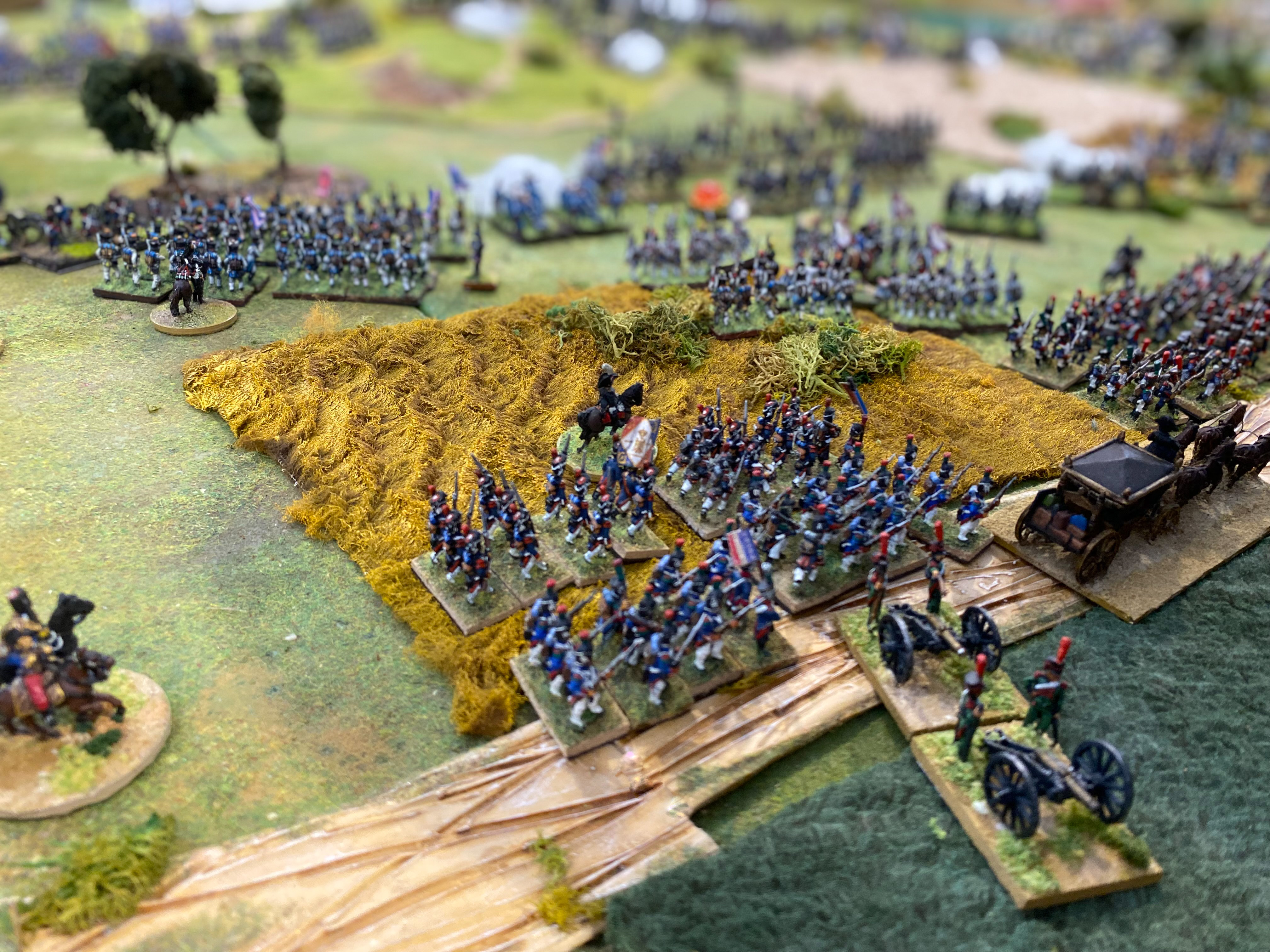
Last week end my mates organized a Black Powder game using a “maxi” table. Around 3,000 miniatures … table 480 x 150 cm … 16 Army Corps … 12 players.


It was not an historical scenario but it is inspired a post Lipsia battle ... around 1813. The idea was to create an event in which players could play a Napoleonic battle for fun with a great number of minis. The French are retreating and the Emperor is ill. 


All minis are 15mm. The Obj of the battle is easy: the Emperor, aboard his carriage, must cross the whole camp using the road on the edge of the French side. The Allies want to take him alive


For the first two turns of game the Emperor and the Guard has significant problems to move even if they can count on a 9 of discipline.

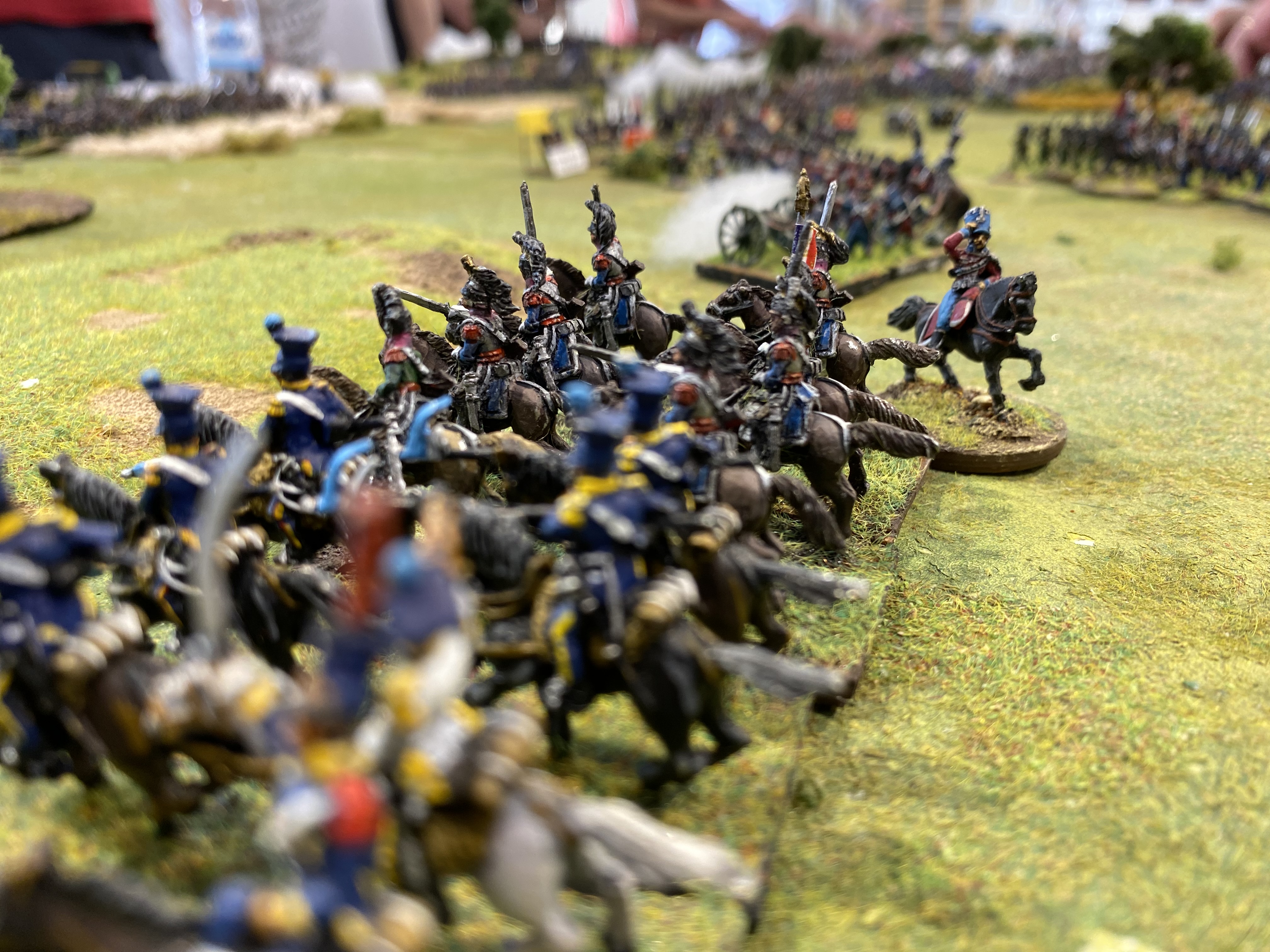
On the French right, two Corps face a Bavarian and Austrian one. The French launch their cavalry against Austrian units but they are not able to create an hole. 


A detail of a Barian unit approaching to the field and ...


... a French cavalry unit


On the French left, the Poles keep the Prussian troops at a distance. The Prussians continue to hammer the French line with rifle and cannon but the Poles hold the line.


The Old and the Young Guard are on the way


On the center Russian Corp try to create an hole and capture Emperor’s carriage but a fresh Napoletan force block them avoiding a catastrophic event.


A detail of a Cossack unit ... 


After 5 turns the French on the right break … Swiss troops try to support this battle side but they arrive too late.


At the 11th turn the Guard arrives laun
ching the cavalry against the first Austrian unit that try to block the Emperor. 


The match end with an Allies victory. 


Unfortunately, Guard's sacrifice is not able to avoid French army break. The Emperor is captured and sent to his exile to Elba island.


venerdì 19 maggio 2023

Foraging duty - Clash of Katanas May, 13 2023

SCENARIO

Last week end my mates decided to play another match using Clash of Katanas. They decided to play a scenario from the main rule book: Foraging Duty (10.2).

The starting set up

Two armies are camped in the poximity of a fertile valley. While they wait the clash the armies need to be fed so their commanders decided to sent out some patrols on scavernging duty. The game started when two opposing patrols become in contact. 


On the table are placed two livstock herd tokens at 24" from table center.  The obj is to bring the herds into the camp. The unit or character takes the herd and the animals move directly away at base contact with him. For each herd that a player manages to get within 12" of their table edge, the enemy will gain a break point at the end of the turn. The opponent can cancel that break point by moving the sheep so that they are no longer full within 12" from the opponent table edge. If the player pushes an herd to touch his table edge, the herd is removed from the table and considered captured by the player. At the end of the turn, the enemy receives two break points for each herd that was captured. The game ends when a side breaks. 

My mates decided to deploy two armies: an Ikko Ikki patrol vs Tokugawa one. Riccardo leads Ikko Ikki while Antonio takes the Tokugawa.

Ikko Ikki is a very particular faction that can include an assassin. The Ikko Ikki army is formed by large numbers of highly motivated but poorly equipped peasants, supported by expertly trained and usually fanatical warrior monks.

THE BATTLE

The engagement phase ends when all tokens are in sight of the enemy…


Tokugawa moves his cavalry on the right while archibugers cover the left side 


Also Tokugawa may include into his list an assassin and a geisha but, for this fight, Antonio has decided not to deploy them. 

Riccardo launches his monks against the archiburgers covered by his men deployed in the center. On the left he send his warriors to take the first group of sheeps.


The first herd is for Ikko Ikki. 
Ikko Ikki 1 - Tokugawa 0


After some turns Tokugawa takes his herd too. Riccardo swings into action his assassin against Tokugawa's leader. Riccardo's assassin kills the enemy warlord and takes the sheeps he had captured before.
Ikko Ikki 2 - Tokugawa 0


Tokugawa leader is killed but the Ikko Ikki assassin is eliminated by his bodyguards 


A group of animals for each player
Ikko Ikki 1 - Tokugawa 1


The fight continues on the Tokugawa's left with the clash of archibugers vs monks


Tokugawa's cavalry tries to take the sheeps but it is repelled


The battle continues but at the end it is a draw


venerdì 12 maggio 2023

Battle of Shevardino Sept, 5 1812 - May 2023

 Last week, to celebrate the May 5, my club mates decided to play a Napoleonic battle. The fight they chose is Shevardino battle. 
They used Black Powder by Warlord games as rule sets. Minis are 15mm painted by Alberto. Shevardino battle was fought during the Napoleonic Russian invasion in 1812.


French troops lead by Alberto, Luca and Marco. While professor Alessandro Barbero, Danilo and his son controlled the Russians. Ezio took the role of arbiter.

In the real batte. On the afternoon of the 5lh of September Napoleon decided to launch an attack on the Shevardino redoubt. He used the 5th Division of Davout’s I Corps were supported by Nansouty’s and Montbrun's I and II cavalry corps. 


Prince Andrei Gorchakov had the task of holding the redoubt. He mustered Neveroski’s 27th Infantry Division plus the 2nd Cuirassier Division, together with several regiments of dragoons, jagers and two squadrons of hussars.


Twelve thousand Russians would have to hold off nearly three times their number. 


They were in a badly situated position with high ground known as the Doronino hill overlooking them to the south west.
At the end, the French captured the redoubt, at a cost of 4,000 French and 6,000 Russian causalties. The small redoubt was destroyed and covered by the dead and dying of both sides.


Also in our game the battle result is a French decisive victory. The victory arrived only at the last turn after being conquered and retaken two times. 


It took us 4 hours to play the scenario. As usual it was a nice day of play.